
What Is GSM Paper? Complete Guide to Paper Weight & Thickness
First published: 17 August 2018 | Updated: 24 June 2026
If you have ever ordered business cards, invitations, or some other printed paper product, you may have heard of the term “GSM.”
Or, perhaps you ordered a printed product in bulk and had to iron out the nitty-gritty details of your purchase, including paper size and thickness. You may have encountered this term during that process.
If you haven’t heard of it, it’s time you did, especially if you’re constantly ordering printed products. This term can help you more precisely specify exactly what you want, whether you’re ordering business cards, flyers, posters, signs, stickers, or any other type of printed matter.
What Is GSM Paper?
GSM stands for “grams per square meter.” For this standard, the weight of various types of paper is measured from a sample sheet cut to one square meter in size. No matter what final size the paper is cut into (like A4, Letter, or a giant poster), its GSM remains the same because it represents the weight of a 1m x 1m sheet for that specific paper.
For example, paper with a weight of 55 gsm will be much, much lighter and thinner than paper weighing 400 gsm. The 400 gsm paper, meanwhile, will be heavy, thick, and much more durable. In addition, 55 gsm paper will not weigh that much when cut to letter- or poster-size.
However, both are still considered 55 gsm paper, because that number represents a certain thickness or thinness.
For instance, the letter-size paper is A4, 55 gsm paper. The first measurement refers to length and width, while the second refers to weight and thickness.
GSM Comparison Table: Common Weights and Their Uses
| GSM Range | Feel & Appearance | Thickness | Common Uses | Banana Print Products |
|---|---|---|---|---|
| 35–55 GSM | Lightweight, translucent | Very thin | Tracing paper, newsprint | Lightweight documents |
| 75–90 GSM | Thin, flexible | Notebook weight | Sketchpads, notebooks | Notepads |
| 90–100 GSM | Standard printer paper | Medium-thin | Household printer paper, letters | Standard copy paper |
| 120–140 GSM | Slightly sturdier | Medium | Promotional posters, flyers | Standard posters, flyers |
| 210–300 GSM | Premium, substantial | Thick | Magazine covers, art paper, watercolour paper | Premium flyers, posters |
| 350–450 GSM | Rigid, cardstock-like | Very thick | Business cards, invitations, luxury packaging | Business cards, premium invitations |
Know your GSM? Choose your product below and start your order
Why Does the Weight of Paper Matter?
As you can probably guess, paper with a lighter weight is best suited for specific applications, while thicker, heavier paper is better for others.
Knowing the ideal GSM for your paper product can help you make a good decision regarding design and the way it will be used.
Here’s an example: Business cards are small but contain important information. They’re often saved or even shared among contacts, business partners, and potential customers. As such, they need to be thicker, stiffer, and more durable than your average piece of paper.
On the other hand, flyers announcing a sale or an event have a temporary use. They communicate information to whoever receives them, and then they’re usually thrown away. As a result, these are often printed on flimsier paper with a lower GSM.
What Are GSM Paper Types and How Are They Used?
There are many standards for GSM paper. The weight determines what the paper is used for, and is often called the paper’s “grammage.”
Here’s a breakdown of the standard weights and their applications:
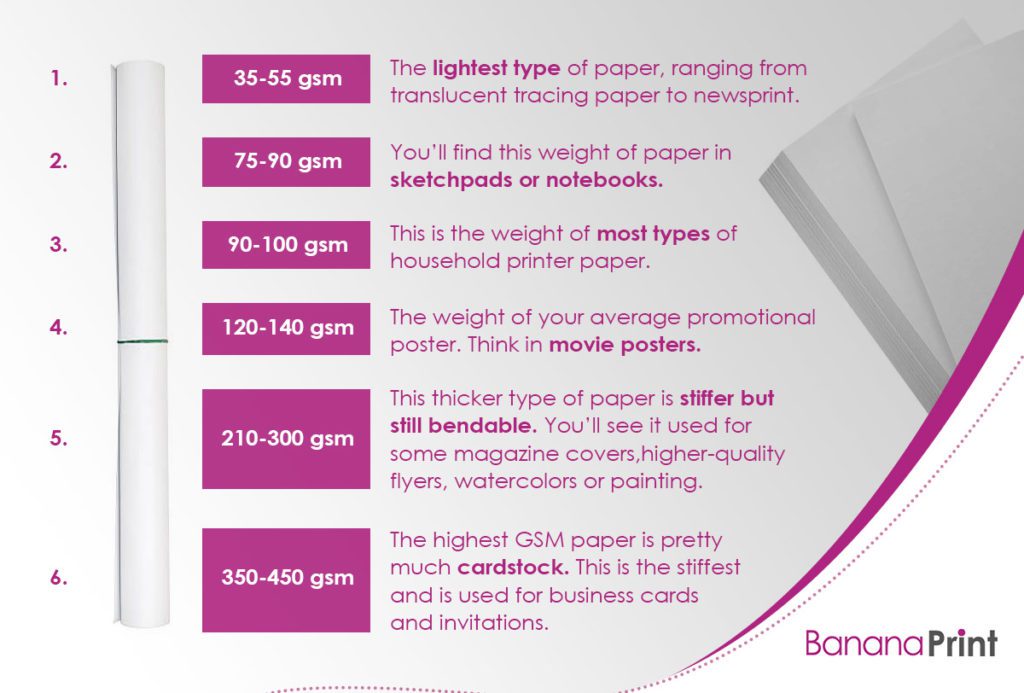
- 35-55 GSM – The lightest type of paper, ranging from translucent tracing paper to newsprint.
- 75-90 GSM – You’ll find this weight of paper in sketchpads or notebooks. It’s thick enough to draw on with a pencil, but heavy ink or marker may bleed through.
- 90-100 GSM – This is the weight of most types of household printer paper.
- 120-140 GSM – The weight of your average promotional poster. Think movie posters hanging on a teenager’s bedroom walls or product posters hanging in store windows.
- 210-300 GSM – This thicker type of paper is stiffer but still bendable. You’ll see it used for some magazine covers and higher-quality flyers. This is also the weight of most paper used for watercolours or painting.
- 350-450 GSM – The highest GSM paper is pretty much cardstock. This is the stiffest, sturdiest paper and is used for business cards and invitations.
Common GSM Paper Sizes and Measurements
Along with paper weight, you also need to make sure you order the correct size for your project or product. For instance, most business cards, brochures, books, and business letters come in standard sizes.
ISO A Paper Sizes and Measurements
An international standard for paper sizing is ISO A, which is measured in meters and millimetres. In this system, the largest format, A0, is one square meter in size.
Each step down in size is achieved by cutting the previous size in half along its widest dimension. For example, the next size down from A0 is A1. The size of A1 is determined by cutting A0 in half.
Here are a few of the most recognisable standard sizes:
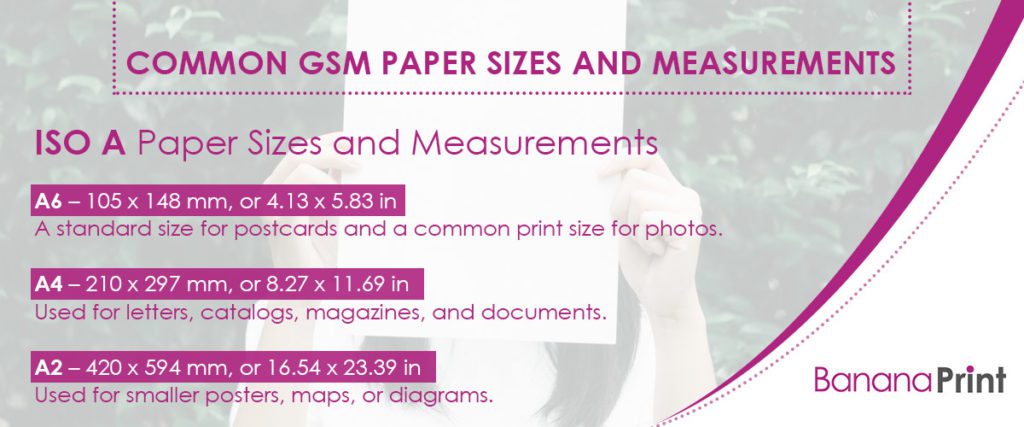
- A6 – 105 x 148 mm, or 4.13 x 5.83 in – A standard size for postcards and a common print size for photos.
- A4 – 210 x 297 mm, or 8.27 x 11.69 in – Used for letters, catalogues, magazines, and documents.
- A2 – 420 x 594 mm, or 16.54 x 23.39 in – Used for smaller posters, maps, or diagrams.
ISO B Paper Sizes and Measurements
Another common global standard for paper dimensions is ISO B. This standard is used mainly for poster sizing, and just like the ISO A sizes, ISO B runs from B0 to B10.
Here are a few examples of sizes and measurements, starting with B0, the largest:
- B0 – 1000 x 1414 mm, or 39.37 x 55.67 in
- B2 – 500 x 707 mm, or 19.69 x 27.83 in
- B4 – 250 x 353 mm, or 9.84 x 13.90 in.
ISO C Paper Sizes and Measurements
ISO C is another global standard, but it applies to the size of envelopes that correspond to and fit the various A sizes of paper.
Here are a few common ISO C sizes:
- C2 – 648 x 458 mm, or 25.51 x 18.03 in
- C4 – 324 x 229 mm, or 12.76 x 9.02 in
- C6 – 162 x 114 mm, or 6.38 x 4.49 in.
Common Ways to Measure Paper Weight
GSM isn’t the only way to measure paper weight. There are a few other systems that use different standards and measurements, which are used in different parts of the world:
1. Calliper
Another way to measure the thickness and weight of paper is to use a tool called a calliper, or a micrometre.
This method uses a tool called a calliper or micrometre, which measures the actual paper thickness in 1/1000-inch increments. This thickness can also be expressed in a measurement called points, such as paper measuring 0.008 inches in thickness being referred to as 8-point media.
2. Basis Weight (U.S.)
In the U.S., a standard method for measuring paper weight is the Basis Weight system.
This system weighs 500 sheets of one paper type (called a “ream”) in its uncut, basic sheet size. The resulting weight is used to categorise the paper, no matter the final cut dimensions. Additionally, each type of paper has its own basic sheet size, so things can get a bit confusing.
The various paper types and their basic sheet sizes are listed below. Among each type of paper, there can be a whole range of weights/thicknesses, measured in pounds:
- Bond, ledger, and copy paper – Basic sheet size: 17 x 22 in – Bond paper is probably what you think of when you imagine paper. This is the most common type found in homes and offices.
- Cover stock – 20 x 26 in – Also known as cardstock, it is often used for paperback book covers.
- Index stock – 25.5 x 30.5 in – Index stock is naturally used for index cards.
- Bristol stock – 22.5 x 28.5 in – Bristol is a thicker, heavyweight paper often used for art. It’s sometimes called paperboard or Bristol board.
- Tag stock – 24 x 36 in – This thicker stock is often used for retail tags attached to items for sale, like clothing.
- Text, book, offset, and coated paper – 25 x 38 in – Text paper is slightly different from bond paper, as it’s usually colored and is more textured. Book paper is the type used in printed books, as it holds up well to printing on both sides. This paper is also more textured than bond paper.
What Is GSM Paper? Answer: An Easy Way to Know Your Paper Thicknesses
Once you understand what GSM paper is, not to mention the other standards for measuring the weight and thickness of paper, it becomes a lot easier to choose the weight that’s right for your project.
At Banana Print, we can help you determine the right weight and size of paper that will perfectly suit your needs. Whether you need business cards, invitations, or any other type of printed product, let us show you what high-quality, professional printing looks like.
Ready to order? Browse our products by GSM weight or upload your design to Banana Print. We’ll handle the rest.